
Can Synonym Rewriting Weaken AI Text Watermarks? Testing WordKingPro
Completed 7 October 2026. Automated pilot report; human quality review pending.
Abstract
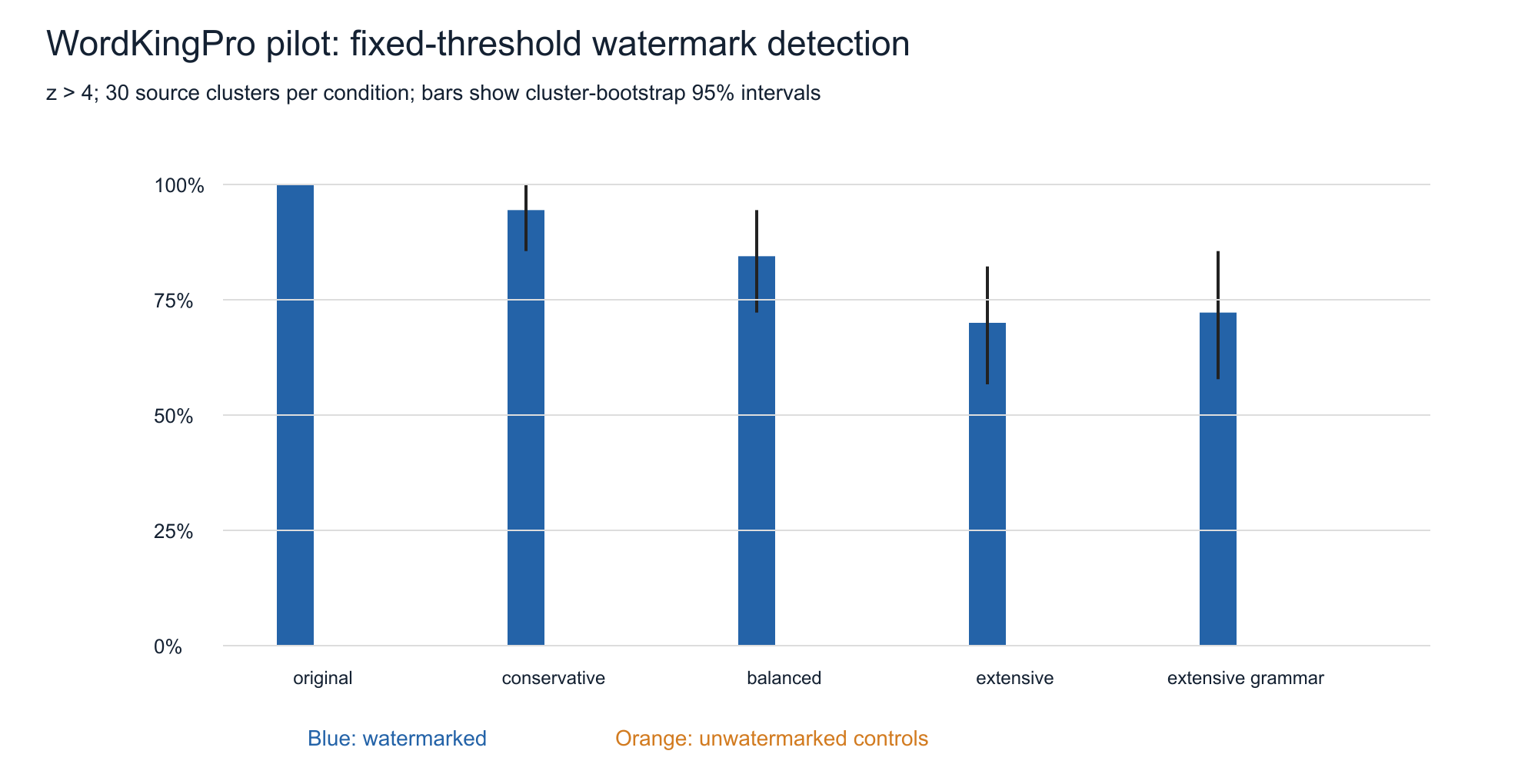
We evaluated WordKingPro on 30 watermarked English passages and 30 matched unwatermarked controls generated with Qwen2.5-0.5B-Instruct and the official Kirchenbauer watermark implementation. Three variants per source were retained for each of four editing conditions. At a fixed detector threshold of z > 4, detection fell from 100% on original watermarked passages to 84.4% for Balanced mode and 70.0% for Extensive mode. The paired Balanced change was −15.6 percentage points (95% source-cluster bootstrap interval −27.8 to −5.6). All 780 text records were scored and audited. These findings establish attenuation of this particular signal; human evidence on meaning and readability has not yet been collected.
Design and reproducibility
The protocol and source hashes were frozen before generation. The study used 30 prompts, ten each for student explanations, general articles and business/product descriptions. Each prompt produced a watermarked and unwatermarked source with the same paired seed and generation settings. The pilot contains 60 unchanged sources and 720 treatment outputs. A locally frozen protocol is not an external preregistration; no registry submission or peer review is claimed.
WordKingPro reported version 3.5.4. Exact engine, dictionary and Harper assets are identified by SHA-256, resolving the site's differing script query label. Presets were Conservative (one alternative, minimum length five, single-word alternatives), Balanced (two alternatives, minimum length four, multi-word alternatives), and Extensive (three alternatives, minimum length three, multi-word alternatives). Proper-noun protection was enabled. Grammar filtering during template construction was disabled. The grammar condition applies one bundled Harper correction pass to each corresponding saved Extensive output.
The watermark used gamma=0.25, delta=2.0 and simple_1 seeding. The correct generating tokenizer, experimental key and CUDA device type were used for detection. Repeated n-grams were ignored and no normalisation was applied. The score tests green-token enrichment; it is not a generic AI-authorship detector. See the frozen protocol and run manifest for full settings.
Detection results
| Treatment | Detected / outputs | Detection rate | Mean z | Mean green fraction | Mean word edit distance |
|---|---|---|---|---|---|
| Unchanged | 30/30 | 100.0% | 11.04 | 53.1% | 0.0% |
| Conservative | 85/90 | 94.4% | 8.04 | 44.4% | 14.2% |
| Balanced | 76/90 | 84.4% | 5.65 | 37.8% | 31.4% |
| Extensive | 63/90 | 70.0% | 4.85 | 35.6% | 36.4% |
| Extensive + grammar | 65/90 | 72.2% | 4.87 | 35.7% | 37.6% |
The 90 outputs in each rewritten watermarked condition are three variants of 30 sources, not 90 independent passages. Intervals resample the 30 prompt clusters and retain their associated variants. Word edit distance counts substitutions, deletions and insertions divided by the original regex word count.
| Comparison against unchanged | Difference in detection | 95% cluster interval |
|---|---|---|
| Conservative | −5.6 percentage points | [−14.4, 0.0] |
| Balanced | −15.6 percentage points | [−27.8, −5.6] |
| Extensive | −30.0 percentage points | [−43.3, −17.8] |
| Extensive + grammar | −27.8 percentage points | [−42.2, −14.4] |
Grammar correction changed detection relative to its corresponding Extensive parents by +2.2 percentage points (95% interval −3.3 to +7.8). This pilot does not resolve a clear incremental detector effect from that step.
Mean scored-token counts increased from 300.4 in original watermarked text to 372.1 for Balanced and 392.1 for Extensive. The green fraction fell from 53.1% to 37.8% and 35.6%, respectively. The measured average signal weakening therefore was not explained by shorter scored passages.
No unwatermarked original or rewrite crossed the threshold: 0/30 originals and 0/90 outputs per rewritten condition. These are correlated variants of only 30 control sources. The Wilson interval for the original control false-positive rate is approximately 0–11.4%; these observations cannot validate a 1% false-positive rate. The original watermarked rate's Wilson interval is approximately 88.6–100%.
The chart is run/analysis/detection-rates.png; machine-readable intervals, scores and descriptive genre strata are in the analysis directory. Bootstrap intervals can degenerate at all-zero or all-one outcomes; this does not imply population certainty.
Quality and detail preservation
There are no completed human meaning or readability ratings. Two separately shuffled reviewer packets contain 300 items each, with output-only readability and original–output meaning tasks. The administrator key is separate. Laya's sampled sentence judgments are supplementary, exploratory and unvalidated; they cannot supply a percentage of whole outputs preserving meaning.
Exact-string diagnostics identified at least one lost supplied fact string in 2/18 fact-bearing watermarked Balanced outputs, 2/18 Extensive outputs and 8/18 Extensive+grammar outputs. Citation-marker multisets changed in 3/90 grammar-corrected watermarked outputs. These flags include formatting or spelling changes and do not, by themselves, prove semantic errors. They identify material for reviewer inspection. Flagged strings in the grammar condition include Harbour Paths, Northbridge Repair Day, Sam Patel, [A2], and 2-year.
Length and scope limitations
Twelve of the 60 originals fell outside the requested 300–500-word range; the observed range was 295–824 words. Nine reached the fixed token cap. All were retained as prespecified. This small model may generate repetition or weak prose; reviewers must distinguish baseline shortcomings from rewriting damage. Results concern one model, one watermark configuration, one product snapshot and three genres. The 30-source pilot does not support strong genre or length subgroup claims.
The study was commissioned by WordKingPro's developer, creating a commercial conflict that must be disclosed in any publication. A future confirmatory study should use held-out prompts, stronger sample-size justification, additional watermark schemes and models, and completed independent quality assessment.
Supported conclusion
On this fixed pilot, WordKingPro weakened the tested statistical watermark, but most rewritten outputs remained detectable: 84.4% in Balanced and 70.0% in Extensive. Whether the reduction is useful while preserving writing quality remains unresolved. This is not evidence of universal watermark removal or performance against unrelated AI detectors.
References and data
- Kirchenbauer et al., A Watermark for Large Language Models.
- Official watermark implementation.
- Complete measured data: pilot-data.jsonl.
- Frozen protocol and settings: PREREGISTRATION.md, config.json, manifest.json.
- Operational amendments and Laya sample: AMENDMENTS.md.
- Reproduction instructions: REPRODUCING.md.